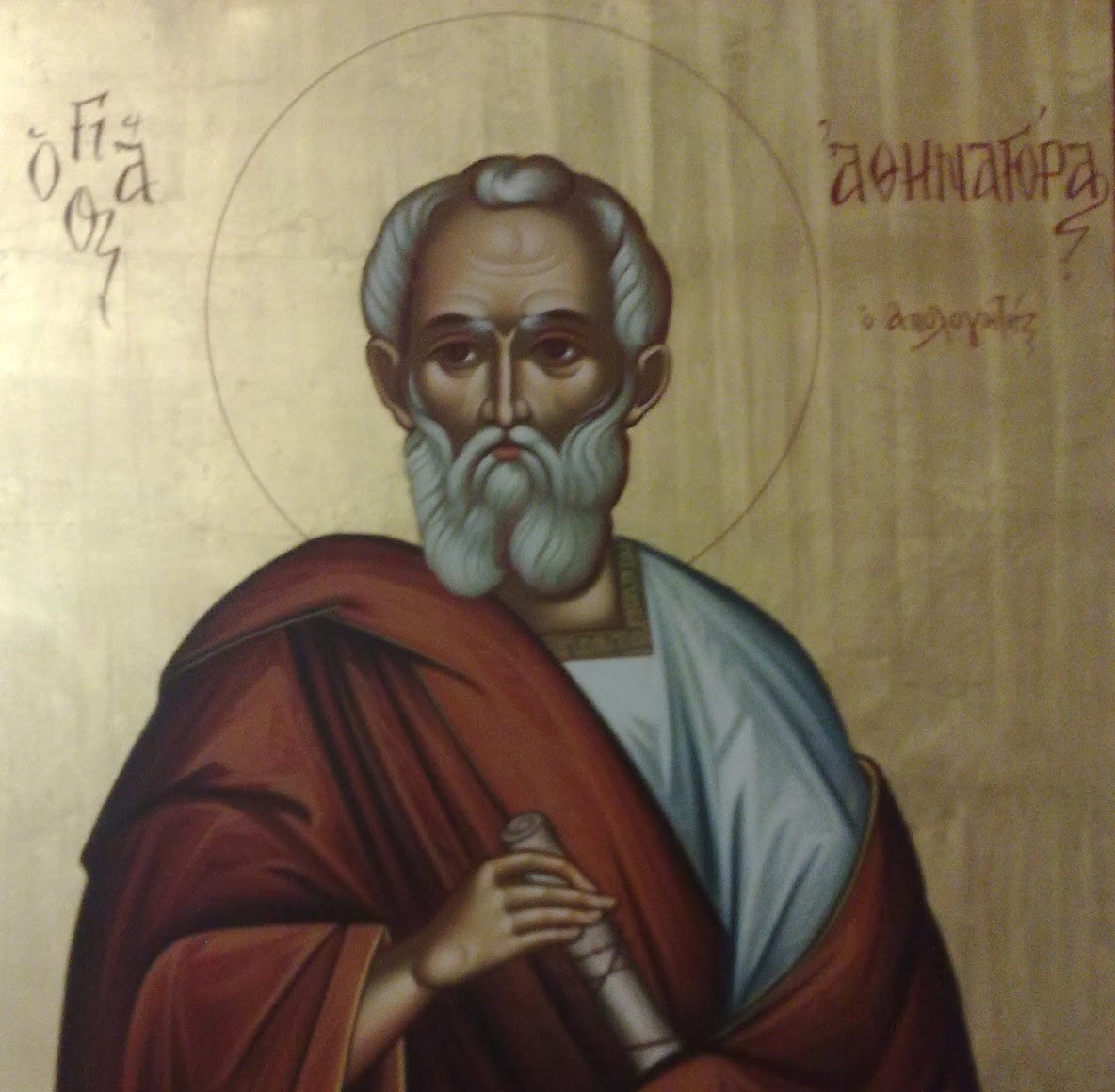
Athenagoras of Athens and His Defense of Christianity

As Athenagoras examined Christianity in the second century, he found it utterly absurd. A religion about a man who was executed as a criminal and returned in a resurrected body? How primitive, he thought! Following Plato, any respectable philosopher knew that the body was a temporary shell for the soul to discard at death.
Convinced of the irrationality of Christian claims, he set out to write a treatise against them. To do so, he studied the Scriptures and the writings of Christian apologists. But the more he read, the more he realized they were right. Being from Athens, he was particularly impressed with Paul’s speech to the Athenians in Acts 17.
Confessing his faith in Christ, he transformed his planned critique into a thorough defense of the resurrection of body and soul: On the Resurrection of the Dead. Using a language readily understood by his fellow philosophers, he argued that God made body and soul for a joint purpose, rather than for one to be discarded. Human hope is not a disembodied existence because a human being is both body and soul. This makes a bodily resurrection not only possible, but necessary.
Like other Christian apologists, he also wrote a letter to the emperor to convince him of the legitimacy of the Christian faith. The emperor was then Marcus Aurelius, who was considered a wise philosopher. Athenagoras included in the letter the emperor’s son and heir to the throne, Commodus.
This letter, known in English as A Plea for the Christians, starts with a question: Why do Roman laws allow citizens from all nations to worship many different gods, but make an exception for the worship of Christ? The Romans agreed “on the one hand, that to believe in no god at all is impious and wicked, and on the other, that it is necessary for each man to worship the gods he prefers, in order that through fear of the deity, men may be kept from wrong doing.” And yet Christians were persecuted. “Why is a mere name odious to you?”[1] Athenagoras asked.
The philosophers who attacked the Christians, Athenagoras said, were all words and no substance. “Who of them have so purged their souls as, instead of hating their enemies, to love them; and, instead of speaking ill of those who have reviled them … to bless them; and to pray for those who plot against their lives? On the contrary, they never cease with evil intent to search out skillfully the secrets of their art, and are ever bent on working some ill, making the art of words and not the exhibition of deeds their business and profession. But among us you will find uneducated persons, and artisans, and old women, who, if they are unable in words to prove the benefit of our doctrine, yet by their deeds exhibit the benefit arising from their persuasion of its truth: they do not rehearse speeches, but exhibit good works; when struck, they do not strike again; when robbed, they do not go to law; they give to those that ask of them, and love their neighbours as themselves.”[2]
He also addressed the baseless accusations leveled against Christians, such as sexual promiscuity – a charge often stemming from the fact that husbands and wives referred to each other as brother and sister in the Lord. Such charges, Athenagoras said, could be more accurately applied to the pagan gods, such as “Zeus, who begot children of his mother Rhea and his daughter Koré.”
In contrast, Athenagoras explained, “We are so far from practising promiscuous intercourse, that it is not lawful among us to indulge even a lustful look. For, says He, he that looks on a woman to lust after her, has committed adultery already in his heart.”[3]
Athenagoras was also one of the first authors to defend the biblical teaching of the Trinity, describing Father, Son, and Spirit as distinct and yet “united in essence.”[4] This proves that the core of the doctrine was embraced by the church long before the Council of Nicea.
Although Athenagoras is less famous today than other apologists such as Justin Martyr, he was highly respected in his own time and his writings served as a foundation for later Christian authors.
[1] Athenagoras of Athens, A Plea for the Christians, chpt. 1 https://www.newadvent.org/fathers/0205.htm
[2] Athenagoras, Plea, chpt. 12
[3] Athenagoras, Plea, cpht. 32
[4] Athenagoras, Plea, chpt. 24