Seven Reflections on Election and Reprobation, Pt. 1

Introduction
Few teachings in the Bible stretch our minds and humble our hearts like the doctrine of predestination, which is God’s eternal decree by which He graciously chooses some to eternal life in Christ and justly passes by others in their sin for His glory. This raises honest and difficult questions about God’s sovereignty and our responsibility, about justice and mercy, prayer and evangelism. Because these questions feel weighty and sometimes uncomfortable, many Christians are tempted to avoid the subject altogether.
Yet Scripture calls us to listen to all that God has revealed, even when it challenges us. The apostle Paul speaks directly about predestination in Romans 9–11, not to encourage endless debate or speculation, but to lead God’s people to humility, trust, and worship. When this doctrine is taught carefully and pastorally, it does not produce fear or indifference. Instead, it deepens our reverence for God, strengthens assurance in Christ, encourages prayer, and sharpens our commitment to share the gospel.
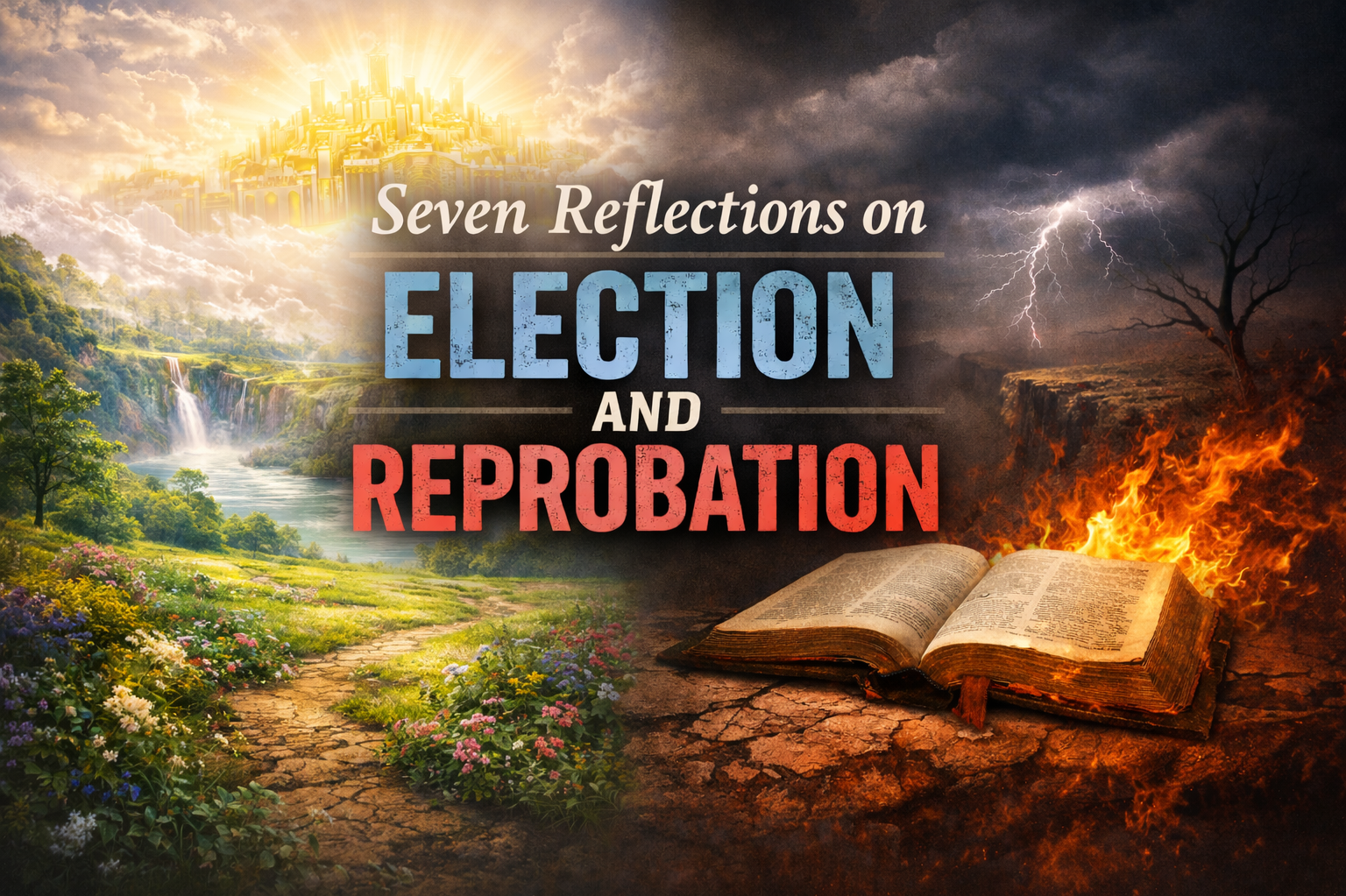
In this post, I offer seven brief reflections on election and reprobation (the two aspects of God’s decree of predestination). These reflections are not meant to answer every question. Rather, they are intended to help us think biblically, worship reverently, and live faithfully before a sovereign, just, and merciful God.
Reflection 1: Election and Reprobation Are a Sovereign Work of God
The doctrine of predestination teaches that both election and reprobation are acts of God’s sovereign will.
Paul illustrates this with Jacob and Esau. Isaac and Rebekah had twin sons, yet before either child was born (before either had done anything good or bad) God declared, “The older shall serve the younger… Jacob I have loved, but Esau I have hated” (Rom. 9:12–13).
Jacob was not chosen because God foresaw his goodness. At the moment of God’s choosing, Jacob had done nothing at all. Election rests entirely on God’s sovereign pleasure. God chose Jacob because He chose Jacob.
The same principle applies to reprobation. When God says, “Esau I have hated,” Esau had not yet committed any actual sin. He was not excluded because of foreseen wickedness. God’s decision (both to elect Jacob and to pass over Esau) was made in eternity, before either child was born.
This is difficult for us to grasp, and Scripture does not pretend otherwise. Yet Paul insists that both election and reprobation flow from God’s sovereignty, not from anything in us. At this point, a natural objection arises: Is this fair? If God chooses some and not others, what about justice? What about human responsibility? What about prayer and evangelism? Paul anticipates that very question in Romans 9:14: “What shall we say then? Is there unrighteousness with God? Certainly not!”
God Himself answers the charge by saying, “I will have mercy on whomever I will have mercy, and I will have compassion on whomever I will have compassion” (v. 15). Paul draws the conclusion plainly: “So then it is not of him who wills, nor of him who runs, but of God who shows mercy” (v. 16). God has the right to show mercy according to His own will.
And here is the crucial point: no one receives injustice from God. All people are sinners and deserve condemnation (Rom. 3:23). Those who are passed over receive justice. Those who are chosen receive mercy. This is the beauty of predestination rightly understood. Election magnifies God’s mercy, while reprobation magnifies God’s justice. Both display His glory. Both are sovereign acts of a holy and righteous God.
Reflection 2: Election and Reprobation Serve God’s Glory
Scripture teaches that both election and reprobation exist for one ultimate purpose: the glory of God.
Paul makes this clear in Romans 9:17–18 by pointing to Pharaoh. God says to him, “For this very purpose I have raised you up, that I may show My power in you, and that My name may be declared in all the earth.” Paul then concludes, “Therefore He has mercy on whom He wills, and whom He wills He hardens.”
God hardened Pharaoh’s heart, not arbitrarily but deliberately. Why? So that His power, holiness, and justice would be displayed. Pharaoh became the stage upon which God revealed His sovereign might, not only to Israel but to the whole world.
This raises a hard question: If not all will be saved, and if some will face eternal judgment, why would God even create the reprobate? Scripture’s answer is sobering but clear: for God’s glory. God’s glory is not opposed to His goodness; rather, His goodness, justice, holiness, and mercy together display His glory.
Hell itself testifies to God’s holiness and justice. There is a hell because God is holy. He does not tolerate sin, overlook rebellion, or compromise His righteousness. Final judgment proclaims that God takes sin seriously and will vindicate His holiness forever.
Many parents feel the weight of this doctrine most deeply. What if one of my children turns out to be reprobate? That question is painful, and Scripture does not invite us to speculate recklessly. Yet even here, one truth remains firm: every human being is created for God’s glory.
If God, in His inscrutable wisdom, allows someone to persist in unbelief, that life still serves His glory by displaying His justice, holiness, and truth. We may not understand how this works in every case, but Scripture assures us that God never acts without purpose, and never apart from His glory.
This doctrine humbles us. It reminds us that history, salvation, judgment, and even our unanswered questions ultimately exist for divine glory.
Reflection 3: This Doctrine Involves Mystery We Must Humbly Accept
Our finite minds cannot fully comprehend the doctrine of election and reprobation. There is real mystery here, and Scripture calls us to humility, not mastery.
No matter how intelligent we are, no matter how well we know the Bible, no matter how many degrees we hold or books we read, this doctrine will always exceed our understanding. God has not revealed everything about His eternal decisions, and He never intended to.
This is why Paul ends his extended discussion of God’s sovereignty in Romans 9–11 not with an explanation, but with adoration. After tracing God’s purposes in election, hardening, mercy, and judgment, he bursts into praise:
Oh, the depth of the riches both of the wisdom and knowledge of God! How unsearchable are His judgments and His ways past finding out! (Rom. 11:33).
Paul reminds us that God’s “judgments” (that is, His decisions) are beyond human investigation. No one knows the mind of the Lord. No one serves as His counselor. No one instructs Him on how salvation should work. “For of Him and through Him and to Him are all things, to whom be glory forever. Amen.” (Rom. 11:36).
This means we do not stand over God as critics. We do not say, “Lord, your plan seems unfair,” or “Let me offer a better solution.” God does not need our advice. He is perfect in wisdom, righteous in all His ways, and holy in all His works.
I’ll be honest: this is not an easy doctrine. As I considered writing on this topic, I was tempted to skip it altogether. Reprobation is not a subject we naturally enjoy discussing. But it is in Scripture, and as pastors, we are called to proclaim the whole counsel of God, not only the parts that feel comfortable.
The prophet Isaiah reminds us why this teaching is so difficult:
8 “For My thoughts are not your thoughts,
Nor are your ways My ways,” says the Lord.
9 “For as the heavens are higher than the earth,
So are My ways higher than your ways,
And My thoughts than your thoughts. (Isa. 55:8–9).
When it comes to salvation, God’s ways operate on a level far above our own. What Scripture teaches may exceed our understanding, but it never contradicts itself or God’s character.
The right response to this doctrine is not speculation or resistance, but reverent worship. Where understanding ends, doxology begins.
Reflection 4: We May Not Question God with a Rebellious Spirit
Scripture draws a clear line between humble inquiry and rebellious questioning. It forbids rebellious accusation against God, but it does permit humble lament and reverent questioning, as seen in the Psalms. When it comes to God’s sovereign purposes, we are not permitted to put Him on trial.
Paul addresses this directly in Romans 9:20–21:
20 But indeed, O man, who are you to reply against God? Will the thing formed say to him who formed it, “Why have you made me like this?” 21 Does not the potter have power over the clay, from the same lump to make one vessel for honor and another for dishonor?
The image is unmistakable. God is the potter; we are the clay. The clay does not dictate its shape, function, or purpose. The potter has the authority to make from the same lump one vessel for honorable use and another for common use.
Paul presses the point further. Some are described as “the vessels of wrath prepared for destruction,” a sobering description of reprobation. Others are “the vessels of mercy, which He had prepared beforehand for glory,” a beautiful picture of election (Rom. 9:22–23). Both exist to display God’s glory: the riches of His mercy and the seriousness of His justice.
This does not mean God is the author of sin. Scripture is careful here. Pharaoh is a clear example. Yes, God hardened Pharaoh’s heart, but Moses also tells us that “Pharaoh hardened his [own] heart” (Exod. 8:32). God’s hardening was judicial; He gave Pharaoh over to what Pharaoh already desired.
This is the same pattern Paul describes in Romans 1: “God also gave them [the reprobates] up to uncleanness, in the lusts of their hearts” (Rom. 1:24). Reprobation is not God forcing innocence into rebellion. It is God handing sinners over to their chosen path.
In the end, no one in hell will be able to say, “This is God’s fault.” Judgment is just. Condemnation is deserved. Sinners perish because of their own sin and unbelief, not because God prevented repentance.
This is a sobering warning. A hardened heart is not neutral. To resist God’s Word repeatedly is dangerous. If someone dies hardened in unbelief, they cannot blame God. The responsibility lies with the sinner who rejected Christ and refused repentance.
Romans 9 does not silence human responsibility; it establishes it within God’s sovereignty. And it calls us, not to argue with God, but to tremble before Him.
To be continued…