Early Heresies: Arianism vs Orthodoxy

We are all too familiar with rioting and unrest in our streets. But riots over theology? Over one letter of the Greek alphabet–literally one iota? Yet the Arian controversy of the fourth century was a decisive juncture for the Church. Would she continue to recognize Jesus of Nazareth as truly, really, and fully God, or would she conclude that he was somehow lesser than God the Father? In AD 318, adherents of orthodoxy took to the streets, confronting Arius’ followers who chanted, “There was a time when Christ was not!”[1]
Before Arius
Since their earliest recorded history, Christians always worshipped Jesus as God. Historian Jaroslav Pelikan summarizes the data: the “oldest surviving sermon of the Christian church after the New Testament,” the “oldest surviving account of the death of a martyr,” the “oldest surviving pagan report about the church,” and the “oldest surviving liturgical prayer of the church.” All testify to the Church’s active and emphatic faith in Jesus as God.[2]
A long string of controversies over how to define this conviction followed. The first difficulty the Church faced was how Jesus could be the infinite, eternal, and unchangeable God and at the same time be born, grow as a man, suffer, and die on the Cross. The second was how God could be one, yet Father, Son, and Spirit all acknowledged as God.[3]
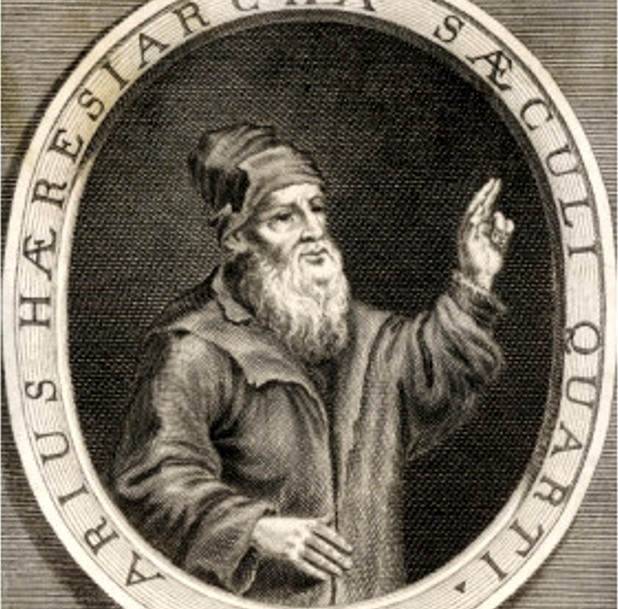
Enter Arius
Arius (AD 256-356) arrived on the scene, a presbyter of eminent learning, to offer a “reasonable” account. God is absolute, without beginning: the source of all reality. The Son, he proposed, must be a creature. The first and most exalted of creatures through which the world was formed, but still a creature. “Begotten,” in this scheme, was a metaphor for the Son’s creation. Divinity cannot be divided. So, “God” for Jesus was only an honorary title.
J. N. D. Kelly summarizes Arius’ four main propositions:
- “First, the Son must be a creature;”
- “Secondly, as a creature the Son must have had a beginning;”
- “Thirdly, the Son can have no communion with, and indeed no direct knowledge of, His Father”–he must know only what God reveals to him;
- “Fourthly, the Son must be liable to change and even sin.” Conveniently, he was providentially preserved from sin, but the Son’s potential fallibility must remain real within Arianism.[4]
Between Two Councils
Arius’ first main opponent was Alexander, Bishop of Alexandria. He recognized Arius’ position not as a progression in Christian theology, but a digression from the Apostolic faith. When Emperor Constantine called for the matter to be settled, the church council of Nicaea (AD 325) convened. The council confessed the Son homoousious (“one substance”) with the Father, and deposed Arius. But Arianism continued to assert itself, pushing to add an iota to the Creed, calling the Son homoiousious (“of like substance”) with the Father. The Empire wavered back and forth.
Athanasius (c. AD 328–373), successor to Alexander both as Bishop and defender of orthodoxy, suffered five exiles for his defense of the Faith. He knew that any compromise with Arianism was a denial of Jesus’ Divinity. His primary contention was that without Jesus being God, he could never save us. In AD 381, the Council of Constantinople sounded the bell of orthodoxy a second time, producing what we now call the Nicene Creed.[5]
We Confess
What can the struggle with Arianism teach us? The most obvious lesson is to resist its errors wherever they surface, whether in aberrant sects like the Jehovah’s Witnesses, modern theologies that subordinate the Son, or declensions of faith among self-professed “evangelicals” who agree, “Jesus is not fully God”.[6]
But further lessons follow:
- Politics and a desire for peace can temporarily derail the church’s witness.
- Subtleties in theology can sometimes be cosmically significant.
- The struggle for orthodoxy can be long and drawn out, represented at times by a seeming minority, calling for the courage and conviction of an Athanasius, Contra Mundum (“against the world”).
What ultimately was at stake in the struggle against Arianism, that we should maintain as doggedly today, is the identity of God’s Son, our Savior, Jesus Christ: “very God of very God, begotten, not made, being of one substance with the Father.”[7]
[1] Justin S. Holcomb, Know the Heretics (Grand Rapids, MI: Zondervan, 2014), 87.
[2] Jaroslav Pelikan, The Emergence of the Catholic Tradition (100-600), vol. 1 of The Christian Tradition: The History of the Development of Doctrine (Chicago: University of Chicago Press, 1971), 173.
[3] Holcomb, Know the Heretics, 89.
[4] J. N. D. Kelly, Early Christian Doctrines, 5th, Rev. Ed. (London: Bloomsbury, 1977), 227-228.
[5] Holcomb, Know the Heretics, 91-95.
[6] “America’s Vanishing Church, with Ryan Burge,” Episode 134 in The Trinity Forum Podcast, accessed online February 9, 2026 < https://ttf.org/podcasts/episode-134-americas-vanishing-church-with-ryan-burge/>.
[7] Quoted in Philip Schaff, The Creeds of Christendom (New York: Harper & Brothers Publishers, 1878), 1: 27–28.