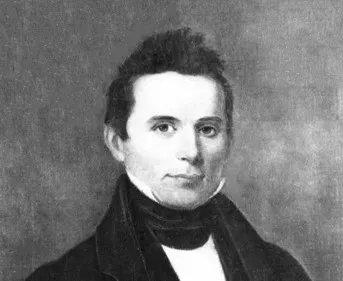
Evan Jones – Supporting the Cherokees on the Trail of Tears

Evan Jones – Supporting the Cherokees on the Trail of Tears
May 26, 1838, was the start of the so-called Trail of Tears, when about 15,000 men, women, and children of the Cherokee nation were forced to give up its lands east of the Mississippi River, relinquishing most of their goods, and to migrate to an area in present-day Oklahoma marked as “Indian territory.” Of these, 4,000 died of hunger, cold, and exhaustion. A missionary, Evan Jones, accompanied them in the march, assisting them as well as he could.
Born in Brecknockshire, Wales, on May 14, 1788, Jones became an apprentice draper at age 15. At the same time, he studied to become a teacher, learning, among other subjects, Latin, Greek, and Hebrew. After moving to London to improve his education, he met Elizabeth (“Eliza”) Lanigan, “a woman of good judgment and education,” in the store where he worked. They married in 1808.
Missionary and Teacher
In 1821, the Joneses and their four children immigrated to Philadelphia, where Evan answered a call from the Baptist Foreign Mission Board to be a teacher for the Cherokee. He was stationed in Valley Town, in today’s North Carolina. Later, he was made superintendent of the mission. One of his pupils, Jesse Bushyhead, became his close friend and translator, and Evan encouraged his ordination a few years later.
Jones found that the Cherokee were interested in learning. As the executive secretary of the Board, Leonard Butterfield, reported in 1835, the Cherokee reasoned: “We want our children to learn English so that the white man cannot cheat us.”[1] Jones was surprised and encouraged by the alacrity and intelligence of the Cherokee children. “Few white children can keep pace with them in learning,”[2] he wrote.
He was however shocked at the opposition he received from other people of European descent, who resented the education Native Americans received, especially when aided by federal funds. “The great objection urged by most people in these parts is the enmity of the old wars in which some of their friends had been killed by them,”[3] Butterfield wrote.
Besides the basic academic subjects, the students at Valley Town learned practical trades, such as husbandry for boys and spinning and weaving for girls. The school for girls was run by Eliza Jones, who also managed the mission while Evan was gone on evangelistic trips. This included overseeing both schools and the Sunday School classes, hosting visitors, and attending to the sick. All this, while raising her children, who also attended the school and helped with the chores. By 1830, the Joneses had five children of their own (some had died in infancy) plus four Cherokee orphaned children they adopted in 1827.
If the Cherokee were eager to study, they were initially reluctant to embrace Christianity, which they saw as a myth. The lackadaisical and skeptical attitude of many white people, coupled with their poor moral example, didn’t help, Jones noted. Soon, however, there was a boom of conversions. Between 1830 and 1838, Cherokee converts grow from 90 to over 500.
Opposition
But while the number of converts was encouraging, the same period brought other concerns, especially after Andrew Jackson became president. A former military leader in the wars against the Natives, Jackson was determined to remove them from areas that were financially important to the colonists (particularly in the south, where the cotton industry required lots of land). His selling point was that whites and natives could never live peacefully together (the same logic used for any type of segregation).
Evan Jones opposed any proposal of forced removal. Being from Wales, he was also opposed to slavery. He was arrested and expelled on separate occasions for his opposition, but each time he successfully appealed.
He also faced accusations of a personal nature. When, in 1831, Eliza died, he was criticized for marrying an assistant at the mission, Pauline Cunningham. Some accused him of having committed adultery with her. Later, a heavier charge of having conspired with Pauline in the murder of her sister Cynthia and her infant child was laid on him. To all accounts, it seems that Cynthia, who had conceived out of wedlock, died during a miscarriage, since the child was discovered, bloodied, between her legs. Jones, who had administered her some pain medications while unaware of her condition, was accused of murder. Eventually, all charges were dropped, but the suspicions lingered in some people’s minds.
The Trail of Tears
In the spring of 1838, when it was clear that removal was inevitable, Cherokee Chief John Ross divided his people into regiments, placing Jesse Bushyhead at the head of one and making Jones the assistant commander of another. Jones was one of the few white missionaries who accompanied Native Americans during their removals. His letters provide an important account of the Natives’ struggle on the Trail of Tears.
After being dragged from their homes with just the clothes they were wearing, the Cherokees were taken to detention camps while awaiting removal. There, about 175 Cherokees asked to be baptized.
During the march, Bushyhead and Jones continued to hold worship services and to care for the people’s physical and spiritual needs. In December, after 75 days of continuous march, with 529 miles behind them and 300 more to go, Jones feared the effects of the advancing winter for the frail and elderly and those who had only thin clothes on their back. Their only remedy was to send someone ahead of the others to start fires at short intervals.
“I am afraid that, with all the care that can be exercised with the various detachments, there will be an immense amount of suffering, and loss of life attending the removal. Great numbers of the old, the young, and the infirm, will inevitably be sacrificed. And the fact that the removal is effected by coercion, makes it the more galling to the feelings of the survivors.”[4]
Evan was joined by his son John in 1854. Together, they worked on a translation of the Bible into Cherokee – a version they insisted on using in their schools, despite opposition from the Baptist Board of Missions.
But the colonists were not the only ones to contest some of the missionaries’ teachings. Some of the wealthy Cherokees who had become slave owners expelled John Jones from their territories for his appeal to free their slaves. Evan voluntarily left for a while during the most heated moments of the Civil War.
Recognition
At their return in October 1865, the Cherokees honored them and their families with full citizenship in the Cherokee Nation to mark over 40 years of faithful service. It was the first time citizenship was granted to persons who were not of Cherokee blood nor married to Cherokees.
“When the Cherokees were poor and covered with darkness, light with regard to the other world was brought to us by Evan Jones, and at a later date by his son, John B. Jones. And we do bear witness that they have done their work well, and that they have striven to discharge the duties incumbent upon them in doing good to the people and performing faithfully their duties to God,” the Act by the Cherokee National Council stated.
Jones retired from mission work in 1870 and died in 1872, at the age of 84. He was buried in Tahlequah, Oklahoma. It is said that he and John converted more Native Americans than any other Protestant missionary in the continent.
[1] Leonard Butterfield to Lucius Bolles, January 12, 1835, quoted in McLoughlin, William Gerald, Cherokees and Missionaries, 1789-1839, New Haven: Yale University Press, 1984, 155.
[2] Evan Jones, Watchman, 1822, quoted in McLoughlin, Cherokees and Missionaries, 155.
[3] Leonard Butterfield to Lucius Bolles, April 1, 1835, quoted in McLoughlin, Cherokees and Missionaries, 155.
[4] Evan Jones, “Letter from the Trail of Tears,” from Baptist Missionary Magazine, 19 (April 1839), p 89 as found at the Sequoyah Research Center, https://www.intimeandplace.org/cherokee/images/trail/jonesletter.html