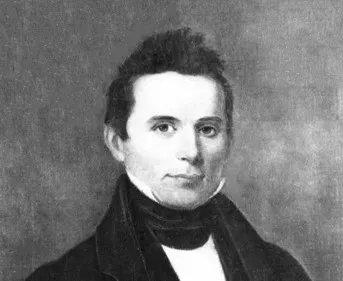
William Apess and the Plight of Nineteen-Century Native Americans

William Apess and the Plight of Nineteen-Century Native Americans
“As the nineteenth century moves on,” W. Robert Godfrey tells us, “Americans are by and large gripped with a new sense of optimism – optimism that they have found a republic successfully, optimism that they are moving westward, optimism in what many called a sense of ‘manifest destiny,’ a sense of providence, that the Lord’s hand is on this nation and wants us to succeed. Now, of course, the question is always, ‘Who is us?’ A manifest destiny was not always successful for Native Americans, and the push westward was justified as what the Lord wanted for the growing European and now Americanized population on the East Coast as they moved west.”[1]
It was a time when many people began to speak against slavery – a subject that later led to the American Civil War. Many writings by abolitionists are still popular today. But while people like Harriet Beecher Stowe or Frederick Douglass are studied in elementary schools, few people know about the Native Americans who spoke out for justice and peaceful cooperation. One of these was William Apess, a pastor and prolific writer who was highly recognized in his lifetime.
A Difficult Youth
Apess was born in 1798 in Colrain, Massachusetts, the oldest of six children, to poor mixed-race parents who soon separated. He then lived with his grandmother who was addicted to alcohol and beat him so frequently and violently that the town’s authorities intervened by moving him into a foster family of European descent.
Apess moved from foster home to foster home until he was old enough to formally become an indentured servant. The families who took him in taught him to fear Native Americans. Their teachings, coupled with memories of the beatings he had received from his grandmother, caused him to run every time he saw anyone with a darker complexion.
But the beatings were not a thing of the past. Once, when depression after the death of a old woman who had been very close to him made him physically sick, the master of the house, convinced this was a work of the devil, and decided to frighten the devil by flogging the boy. This was just one of many beatings he received in various homes during his indenture.
Conversion
The families Apess served were Christian, but nothing in what he heard and saw impressed him as much as his first visit to a Methodist church in 1813. At that time, Methodists didn’t enjoy a good reputation, but it was only there that Apess understood that “Christ died for all mankind – that age, sect, color, country, or situation made no difference. I felt an assurance that I was included in the plan of salvation with all my brethren.”[2]
While his heart and attitudes had changed, understanding how to live a Christian life under trying circumstances was difficult. Once, after being falsely accused, he decided to run away with another enslaved young man and enlisted among the troops fighting the Anglo-American War of 1812.
Discharged from the war in 1815, Apess went to find his parents and other relatives who lived in the Colchester, Connecticut area. There, he found a job and a Methodist church where he was baptized. He also met another Christian or mixed racial background, Mary Wood, who became his wife in 1821.
In 1829, the church confirmed Apess’s desire to be a preacher by ordaining him and assigning him to preach throughout New England and New York, where he faithfully communicated the same gospel that had changed his life.
A Powerful Writer
While preaching, Apess began to write his autobiography, A Son of the Forest, which was published in 1831. He followed it almost immediately with two other writings: The Increase of the Kingdom of Christ: A Sermon, and The Indians: The Ten Lost Tribes (1831). Two years later, he published The Experiences of Five Christian Indians of the Pequot Tribe, the stories of five Native American Christians.
Apess started this last book with his own story, summarizing what he had written in his autobiography, and went on to tell about four women, two related to him (his aunt Sally George and his wife Mary Wood, who wrote her own story). Following conversion, all of these Christians went on to a life of service to others. One of them, Hannah Caleb, taught young Native children to read and write. These stories are a vivid testimony of the power of the gospel that allowed people who had been abused and mistreated to overcome their resentment and extend their love to those who looked down on them. Mary died before the book was published.
Apess ended the book with a reproof to Christians of European descent, A Looking Glass for the White Man, where he explained the deceptiveness of their common prejudices against Native Americans.
Apess’s life was not without controversies. Many condemned him for participating in the Mashpee resistance of 1833-34, in which the Mashpee Wampanoag people of Massachusetts restored their self-government. Since the Mashpee forcibly prevented the authorities from entering their land, their action was labeled as a riot, with the governor threatening to call the state militia. Apess was among those who were arrested, imprisoned, and condemned to pay a fine.
To set the record straight, Apess published a booklet, Indian Nullification of the Unconstitutional Laws of Massachusetts Relative to the Marshpee Tribe; or, The Pretended Riot Explained, explaining how the Mashpees’ actions were nonviolent and rightful.
Around the end of his life, he moved to New York City with his second wife Elizabeth and their children. He died of a cerebral hemorrhage at the age of 41. Modern scholarship, based on medical reports, has refuted some common accounts of his death by alcoholism.
Legacy
Today, Apess is considered the most important Native American intellectual before the 20th century. Barry O’Connell’s 1992 edition of Apess’s writings (collected into five books) generated new interest. The clarity of his writings, based on informed research, helped a new generation to examine his arguments with respect and come to terms with the questions raised by Christian Native Americans in their attempts to separate the true gospel from the inconsistencies of their oppressors who claimed to follow the same Scriptures. In spite of the grim realities they present, these writings succeed in magnifying the power of the gospel to call to new life individuals who had plausible reasons to reject it.
This is consistent with Apess’s hope. By bringing up painful experiences, he wanted to promote an awareness that seemed to be absent in his day – “a looking glass” for those who had been shielded from some historical facts – with the ultimate goal of mutual forgiveness and reconciliation. As he explained at the end of his Eulogy on King Philip (a leader of a Wampanoag rebellion against English invasion), “You and I have to rejoice that we have not to answer for our fathers’ crimes, neither shall we do right to charge them one to another. We can only regret it, and flee from it, and from henceforth, let peace and righteousness be written upon our hearts and hands forever.”
[1] W. Robert Godfrey, Sunday School Lecture, Escondido United Reformed Church, February 25, 2024, https://www.escondidourc.org/sermons/2024-02-25-sunday-school/
[2] William Apess, A Son of the Forest, 19.