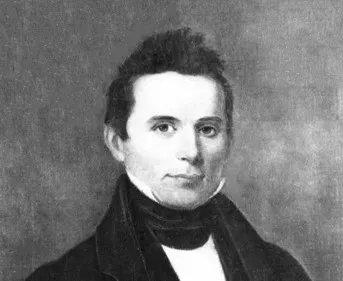
Adolphe Monod – The Voice of the French Awakening

Most Christians are aware of the American religious awakening of the 18th century, known as the Great Awakening and popularized by a recent documentary. They are also familiar with the revivals that took place around the same time in the British Isles. Few know about another revival that spread throughout Europe and had reverberations abroad – the Swiss and French Revéil.
Among the main representatives of this Revéil was Adolphe Monod, often remembered as “the voice of the French Awakening.” His influence, however, might have been difficult to imagine when he entered the pastoral ministry as a young man plagued by doubts.
Uncertain Beginnings
Monod was born on January 21, 1802 in Copenhagen, the sixth of twelve children. Both his father and grandfather were pastors. He moved to Paris with his family in 1808 where he started his studies, completing them in Geneva. Like three of his brothers, he felt called to the pastorate.
At that time, Geneva hosted a mixture of religious beliefs, including heretical tendencies. Most Christians were confused about the most fundamental doctrines. French philosopher Jean-Jacques Rousseau reported that this ignorance spread even among the ministers. “They do not even know what they would wish to appear to believe. Their only way to establish their faith is to attack the faith of others,”[1] he wrote.
A Scot, Robert Haldane, had brought the message of the gospel in 1817, teaching a series of lessons on Romans to interested students. But he was gone by the time Monod arrived. It was only when another Scot, Thomas Erskine, passed through Geneva, that Monod began to catch a glimpse of the gospel.
But his first encounter with Erskine didn’t erase Monod’s doubts. Reading the Epistle to the Romans one year after his ordination, Monod found nothing but a reason to despair. It was in that confused state that he accepted a call to pastor a small congregation in Naples, Italy.
He knew he was not in the right frame of mind to lead anyone to Christ. Yet, these believers were without a pastor. Should he leave them on their own, or preach what little gospel he had heard, in spite of his doubts. He chose the second option, remembering what a Moravian believer once told John Wesley: “Preach justification by faith before having believed it and you will soon preach it because you have believed it.”[2]
During this time, he received letters from his family, assuring him of their prayers. His sister Adèle, whose six-month-old daughter had just died (the second of her children to die in infancy), encouraged him to turn to the same “charitable Redeemer who saves me from despair and murmuring.”
“Adolphe, dear Adolphe, give Him your heart,” she wrote. “Do not seek to understand Him. You will understand Him enough once you have learned to love Him.”[3]
As much as he loved his sister, Adolphe could not yet reply with the good news she might have expected. Yet, her words left a strong impression on his heart.
Following his father’s advice to go out and find a distraction to his torment, he went to a ball, but left immediately when a young girl asked him: “Are you here to prepare your sermon for tomorrow, sir?”[4]
Conversion and Controversy
His crisis ended in July 1827, not long after his sister’s letter – a date he remembered as the day of his conversion. Recounting that day years later, he wrote: “It was not new arguments or having objections resolved that gave me this helpful direction. Rather, sensing at the bottom of my heart that I was helplessly miserable, I threw myself, without reasoning or reserve, into the arms of a God of love, whom the gospel revealed to me.”[5]
Around the end of 1827, he was called to a pastor the large Reformed Church of Lyon. It was a great responsibility for a young man. But the church’s consistory was in for a surprise. They had expected a traditional pastor like Monod’s father. Instead, Monod had just discovered the freedom and power of the true gospel and preached it with all the enthusiasm of his youth, defying the consistory’s claims that “the holiest of all religions will always be the religion of good works.”[6]
They asked him to change his preaching. When Monod asked for clarifications, he understood they meant “that I should preach and act as if I did not believe in free salvation – I replied that I could not do so.”[7]
Another point of controversy was Monod’s complaint that many unbelievers were admitted to the Lord’s Supper. Enraged by his implicit accusation of a lack of faith and by his refusal to administer the Supper during Pentecost, the consistory asked him to resign. Monod refused, asking for careful investigation of his teachings and a clear explanation of how he had erred.
In the meantime, he took some time off to visit his parents, partially to ask for their opinion on his potential marriage to Hannah Honyman, a parishioner from a Scottish family. Despite their concerns about the couple’s lack of finances, Monod’s parents gave their approval and the couple married in 1829. Hannah provided joy and comfort during Monod’s difficult dealings with the consistory.
Pastor and Professor
Eventually, in 1832, the French government, which at that time oversaw all churches, decreed that Monod should leave his position. Despite other valuable offers, Monod chose to stay in Lyon to pastor a group of about seventy people who had left the established church. He was encouraged to do so by his older brother Frédéric, who told him: “The Christians of Lyon must not be abandoned. It is of great importance to show the consistories that if they can remove faithful pastors from the national church, they cannot remove the gospel from those places where it has begun to be preached.”[8]
This new church grew in numbers and maturity. In 1836, however, Monod was offered a teaching position at the Theological Seminary at Montauban. This time, he accepted, believing that he could have a greater influence in helping the church in France to understand the true gospel. Thankfully, God provided a good pastor to take his place in Lyon.
Monod remained at Montauban almost ten years, teaching ethics, preaching, Hebrew, and exegesis. Free from his pastoral duties, he found more time to devote to his family, that grew to include seven children. He and Hannah also opened their home to seminary students, as well as to Monod’s sister Adèle and her family, since her husband’s health required a mild climate.
At the same time, Monod accepted invitations to preach from various churches, especially during school breaks. His reputation became so established that in 1842 he was granted an honorary doctorate in divinity by the College of New Jersey (now Princeton University). He was also one of the founders of the Evangelical Alliance, based in London.
He returned to the pastoral ministry in 1847, when he accepted a call from the Temple de l’Oratoire, the Reformed Church of Paris. His brother Frédéric was also a pastor there, and the position allowed them to be close to their mother and other family members (his father had died in 1836). This time, he received an enthusiastic welcome by the church, including its consistory.
In 1848, the French Reformed Church convened its General Assembly to discuss a possible revision of the Gallic Confession (or Confession of La Rochelle), which had been its confessional statement since the sixteenth century. A liberal group of pastors didn’t even want a confession, while conservatives like Adolphe and his brothers saw its importance but advocated for changes. In the end, the Assembly voted not to change the confession. Frédéric disagreed with this decision which, in his view, left too much room to the liberal wing of the denomination.
Eventually, Frédéric left the French Reformed Church to form the Union of Evangelical Churches. Conversely, Adolphe chose to stay to continue to work changes from within. After all, he reasoned, the Assembly’s decision had left the Gallic Confession still in place. In spite of this disagreement, Adolphe and Frédéric continued to work together for the promotion of the gospel.
A Ministry of Suffering
Adolphe continued his busy pastoral schedule until 1854, when a serious illness forced him to delegate many of his responsibilities. A year later, his doctors diagnosed it as cancer of the liver. He preached his last sermon on May 27, 1855 – Pentecost Day – from John 4:14.
After the doctors’ diagnosis, Adolphe’s eleven siblings came to visit him. On two consecutive evenings, they celebrated the Lord’s Supper around his bed, with Adolphe giving a farewell message. This gave them the idea of doing the same thing every week. For the next six months, a small group of family and friends gathered around Adolphe’s bed to celebrate the Lord’s Supper, with different pastors presiding. Each time, in spite of his increasing pain, Adolphe gave a short message, sharing lessons he had learned from his suffering, always focusing on Christ.
Adolphe died on April 6, 1856. A month after his death, his siblings, who had been taking notes of his farewell messages, published them in a book entitled, Les adieux d’Adolphe Monod à ses amis et à l’Église (Adolphe Monod’s farewells to his friends and church) – which is today the best-known of his writings. His influence continued in the Reformed Church of France and beyond.
[1] Jean-Jacques Rousseau, quoted in Malan, Arthur Noel, Solomon Caesar Malan, D.D.: memorials of his life and writings (London: John Murray, 1897), 10.
[2] Quoted in Constance K. Walker, Adolphe Monod (Darlington, England: EP Books, 2013), 58.
[3] Walker, Adolphe Monod, 60.
[4] Walker, Adolphe Monod, 61.
[5] Walker, Adolphe Monod, 66.
[6] Michael A. G. Haykin and Constance K. Walker,“Adolphe Monod (1802-36) – The Voice of the Réveil,” in Jean D. Decorvet, Tim Grass, Kenneth J. Stewart, eds., The Genevan Réveil in International Perspective (Eugene, OR: Wipf and Stock, 2023), 257.
[7] Walker, Adolphe Monod, 79.
[8] Walker, Adolphe Monod, 96-97.