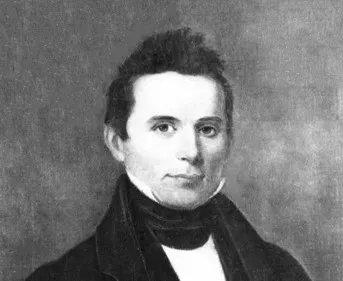
Elias Boudinot – Cherokee Editor and Leader

Many have heard of an American Founding Father named Elias Boudinot. As a President of the Second Continental Congress, a president and founder of the American Bible Society, and a signatory of the Treaty of Paris (which formally ended the American Revolutionary War), he deserves an article of his own.
This article is instead about a Cherokee man named at birth Galagina (The Buck) Oowatie who was so impressed by the founding father’s character and ideas that he asked for his permission to adopt his name. The founding father, who was equally impressed by the young man, was happy to give it.
Our Boudinot was born around 1802, the eldest son of nine children of Oowatie and Susanna Reese, of mixed Cherokee and European ancestry. He adopted the name Elias Boudinot in 1819 when he enrolled at the Foreign Mission School in Connecticut. From his youth, Boudinot was convinced of the importance of education and committed to promote it among his nation – both for their prosperity and their survival. He formally converted to Christianity in 1820. In 1824, Boudinot collaborated with others in translating the New Testament into Cherokee.
A Controversial Marriage
In 1826, Boudinot married a fellow student, Harriet Ruggles Gold, the daughter of a prominent New England family. Interracial marriages were then highly controversial. Just one year earlier, the marriage of Boudinot’s cousin John Ridge to a white woman he had met at the same school raised the fury of many colonists. Boudinot faced similar challenges. At first, Harriet’s parents were firmly opposed to the marriage, but when she became so sick that her life seemed to be in danger, they relented and gave their consent.
Harriet’s priest also tried to dissuade her from marrying a Cherokee. He told her that if she changed her mind, he would not mention her intentions to anyone, but if she didn’t, he would have to post the news of the engagement and people would react.
And react they did. After throwing a furious fit at the news, Harriet’s brother Stephen wrote to his brother-in-law: “The dye [sic] is cast. Harriet is gone.” He then led other young people in a march through the streets of their town with effigies of the couple, which they later burned in protest. Only Harriet’s sisters supported her choice.
Although the American Board of Commissioners for Foreign Missions (ABCFM) stated that the Bible did not forbid interracial marriages, the trustees of the Foreign Mission School decided to close it “lest any more dark-skinned men try to marry their white-skinned women.”
The prominent ABCFM missionary Jeremiah Evarts, however, was concerned about Boudinot’s soul. Apparently as a reaction to the hatred he encountered, Boudinot attended a Cherokee stickball game that included debauchery and drinking. Evarts warned other colonists that their racist behavior was detrimental to the gospel.
Since the Cherokee National Council had recently passed a law enabling the descendants of Cherokee fathers and white mothers to be full citizens of the Cherokee, the Boudinots moved to New Echota, in the Cherokee nation, where they raised their six children.
Defending Cherokee Rights
The same year, Boudinot delivered an important speech in the First Presbyterian Church in Philadelphia, describing the similarities between the Cherokee and the whites, and ways in which the Cherokee were adopting aspects of white culture. Following the speech, he published his speech in a pamphlet by the same title. “An Address to the Whites” was well received and “proved to be remarkably effective at fund-raising”.
In 1828, Boudinot was elected editor of the bilingual Cherokee Phoenix, the first to be published by a Native American nation. For Boudinot, the newspaper was more than a source of information about important news and recent laws. It was a way to tell the colonists that the Cherokee were not savages, but highly civilized and deserving of running their own nations.
Boudinot used every means at his disposal to promote the cause of the Cherokee and expose the injustice of a system that privileged the demands of the colonists who grasped at every excuse to take over Indian land. In 1832, however, he lost hope and began to see the removal of the Cherokee from Georgia as an inevitable event that could only be alleviated.
An Unpopular Decision
When other Cherokee heard of his changed position, he faced much opposition, particularly by John Ross, the Cherokee chief. Knowing that he could not express his views on the Cherokee Phoenix, he resigned from his position as editor.
Believing that acceptance would guarantee the best conditions for his people, in 1835 he joined a handful of Cherokee in signing the Treaty of New Echota, agreeing to the removal of the Cherokee from their ancestral lands in exchange for substantial compensation and some lands in present-day Oklahoma. Boudinot believed that, without this treaty, the US government would have been able to forcibly remove the Cherokee without adding provisions in their favor. But the treaty infuriated Ross and other Cherokee, especially since the signatories had not acted in any official capacity.
To the opposition of most Cherokee, these years brought additional pain to Boudinot, as his wife Harried died in August 1836, probably of complications from her seventh childbirth (a stillbirth).
A year later, he married Delight Sargent, a New England woman who had been a teacher at New Echota. The couple moved to Park Hill in the Cherokee Nation, Indian Territory, where the rest of Cherokee arrived in 1839 after a long trek which is now known as the Trail of Tears.
On June 22, some embittered Cherokee lured Boudinot out of his home by asking him to buy them some medicine. They attacked him and stabbed him to death along the way. His cousin John Ridge and uncle Major Ridge, who had also signed the Treaty of New Echota, were killed the same day, while his brother Stand was attacked but survived.