Alcuin of York, Part 1

Introduction
About three hundred and twenty-five years after Alaric sacked Rome, and the light of the Eternal City was fading into twilight, indeed, with the sudden rise of vicious Viking raids around Europe, these were dark days. What made them darkest though was that the classical education of Greece and Rome had all but disappeared. Only a few schools in Rome still taught the classics but the brightest school was to be found at the edge of the world in York on the Isle of Britannia. And it was there, under the tutelage of Ælbert that a star student was rising, Alcuin. These are the days of Charlamagne, St. Boniface and St. Benedict and yet even though all these names are well known today (and even exalted as models for how to live in decaying times, i.e. The Benedict Option and the newer Boniface Option), it was Alcuin of York (b. 735 AD) who was most revered. And yet sadly, he’s the least known today.
Becoming a Scholar
Schooled in the classical education of the Trivium (Grammar, Logic, and Rhetoric) and Quadrivium (Arithmetic, Geometry, Astronomy and Music), Alcuin was also reared in a distinctly Christian culture with a distinctly Christian understanding of education. At this point in Western history there was a salvific emphasis to learning. Knowing how to read and write were most necessary to know Scripture and to communicate to others the truths of the Christian faith. But at York, learning went beyond mere Christianity. Though the education was certainly devoted to knowing the Bible and knowing the God of the Bible, Alcuin’s teacher and mentor, Ælbert saw all the universe as hard-wired by Wisdom (personified with a capital W, of whom he understood as the divine Word, the Son of God). And for Ælbert all of creation was organized by a divine rational Logos and mankind, by God’s design, was made to observe and understand it. So Ælbert repeatedly taught that “humans were not the inventors of the liberal arts, [but rather] they discovered them in things.”
In a wonderful providence it was a young Alcuin and his teacher Ælbert who travelled the continent seeking to rescue books from being burned by Saxon pagans, putting them to use in the safety of their school in York. Skipping ahead to the end of Alcuin’s life, when Vikings began raiding and burning all of Britannia, including incursions in Northumbria (near York), it was Alcuin who now as head tutor in Charlamagne’s court in Francia, was writing to York and telling his old friends that he could not find key books anywhere on the continent, books he knew were in his old library at York, books like Boethius’ The Consolation of Philosophy, and so he wrote to his old friends encouraging them to send all the Great Books to him for safe keeping. It is no exaggeration to suggest that Alcuin may have single-handedly saved and preserved some of the West’s greatest classical and Christian books we still benefit from today.
Recognition & Influence
It was of course after Ælbert dies and Alcuin takes over teaching at York where he becomes recognized as a world-renowned teacher, attracting students from all over the continent. Under Alcuin, the Cathedral and school at York was, in the words of historian Joanna Story, “the most remarkable center of learning in Western Latin Christendom.” Specifically, Alcuin used what some have called a distinctly Anglo-Saxon teaching technique, things like humor, the use of puns, riddles, jokes and very clever mathematical puzzles.
Indeed, some of Alcuin’s famous riddles are still used today! Imagine you’re off to the market. You’re selling a wolf, a goat, and a bunch of cabbages. The road is rough and dangerous, and you’ve had to keep a constant eye out to make sure the wolf doesn’t eat the goat and the goat doesn’t gobble up the cabbages. You’re nearly there, but now there’s one more obstacle: a river to cross. Fortunately, there’s a boat, but it’s so small that you can only take one thing across at a time. So how do you get everything across the river without anything getting eaten? That classic puzzle came from the mind of Alcuin.
It’s in 780 when Alcuin will meet Charlamagne, who’s Carolingian kingdom is growing, not only in prestige and power but also has a wide geographical presence – at the height of his reign, His conquest of not only the Saxons, but also the Lombards, Bavarians, and peoples of northern Spain made him master of virtually the entirety of the Christian West. Only Britain, southern Spain, and southern Italy were not under his control. And it was during this providential meeting where the king asks the famed teacher to do in Francia what he’s accomplished in York. This becomes Alcuin’s greatest endeavor.
In one letter we have from Alcuin, we see his vision for what he wants to accomplish: “If your intentions are carried out, it may be that a new Athens will arise in France and an Athens fairer than of old, for our Athens, ennobled now by the teaching of Christ, will surpass the wisdom of the Academy. The old Athens had only the wisdom of Plato to instruct it, yet even so it flourished by the seven liberal arts. But our Athens will be enriched by the sevenfold gift of the Holy Spirit and will, therefore, surpass all the dignity of earthly wisdom.” John Duggan, writing for First Things, says this about this quote: “Here, at the end of the eighth century, a scholarly monk, writing to a barbarian king, sketched a system that would strive to unify faith and reason, spirit and intellect, religion and science, Christianity and humanism, AD and BC.”
This is Classical Christian education at its clearest and again, it is no exaggeration to say that it was Alcuin who saves and establishes real education in the West! Specifically, Alcuin understood that a good education did not throw out the old liberal arts of Greece and Rome, pagan though they were. A student of Augustine he believed that truth found anywhere was and is God’s truth. As the Jews plundered the Egyptians of all their treasures, ought not the church to plunder the treasures of Greece and Rome? “In times past,” wrote Alcuin, “the truth they taught was clearly good for society; but now – infused by True Wisdom, a greater and more perfect learning can change the world for better! Rather than philosophers gaining fame by their wisdom, Christ [who for Alcuin is the Wisdom of God incarnate] will receive all adoration and praise.”
In another letter to Charlemagne, Alcuin wrote of the actual education he was overseeing at the monastery of Tours in central France: “I… am doing as you have urged and wished. To some who are beneath the roof of St. Martin I am striving to dispense the honey of Holy Scripture; others I am eager to intoxicate with the of wine of apples of grammatical refinement; and there are some whom I long to adorn with the knowledge of astronomy, as a stately house is adorned with a painted roof.” His was a full-orbed education. One where all the ingredients worked together because all truth coheres under God’s creative wisdom. For Alcuin, nothing is out of sorts.
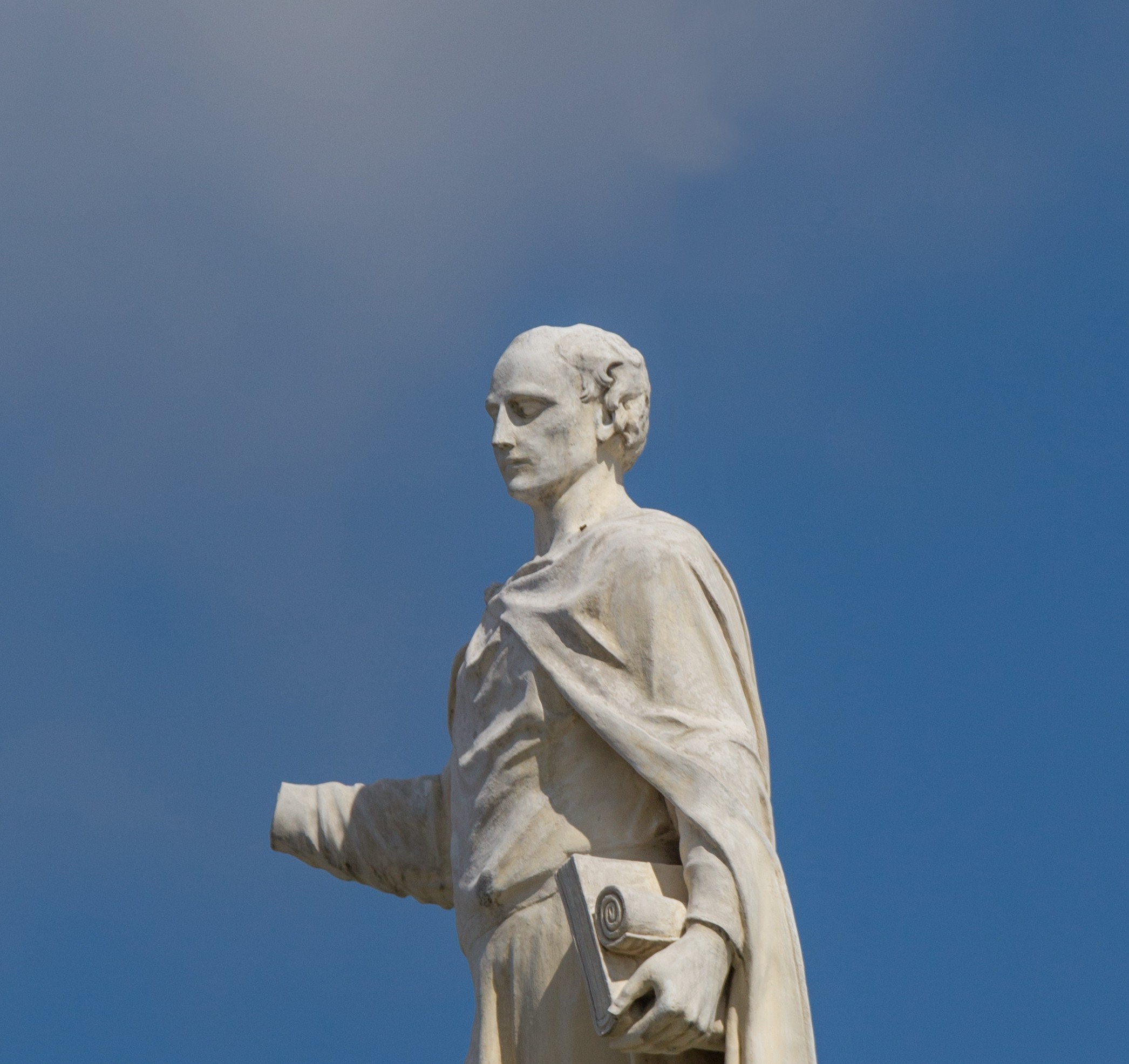
image: By © Hubertl / Wikimedia Commons, CC BY-SA 4.0, https://commons.wikimedia.org/w/index.php?curid=46198351