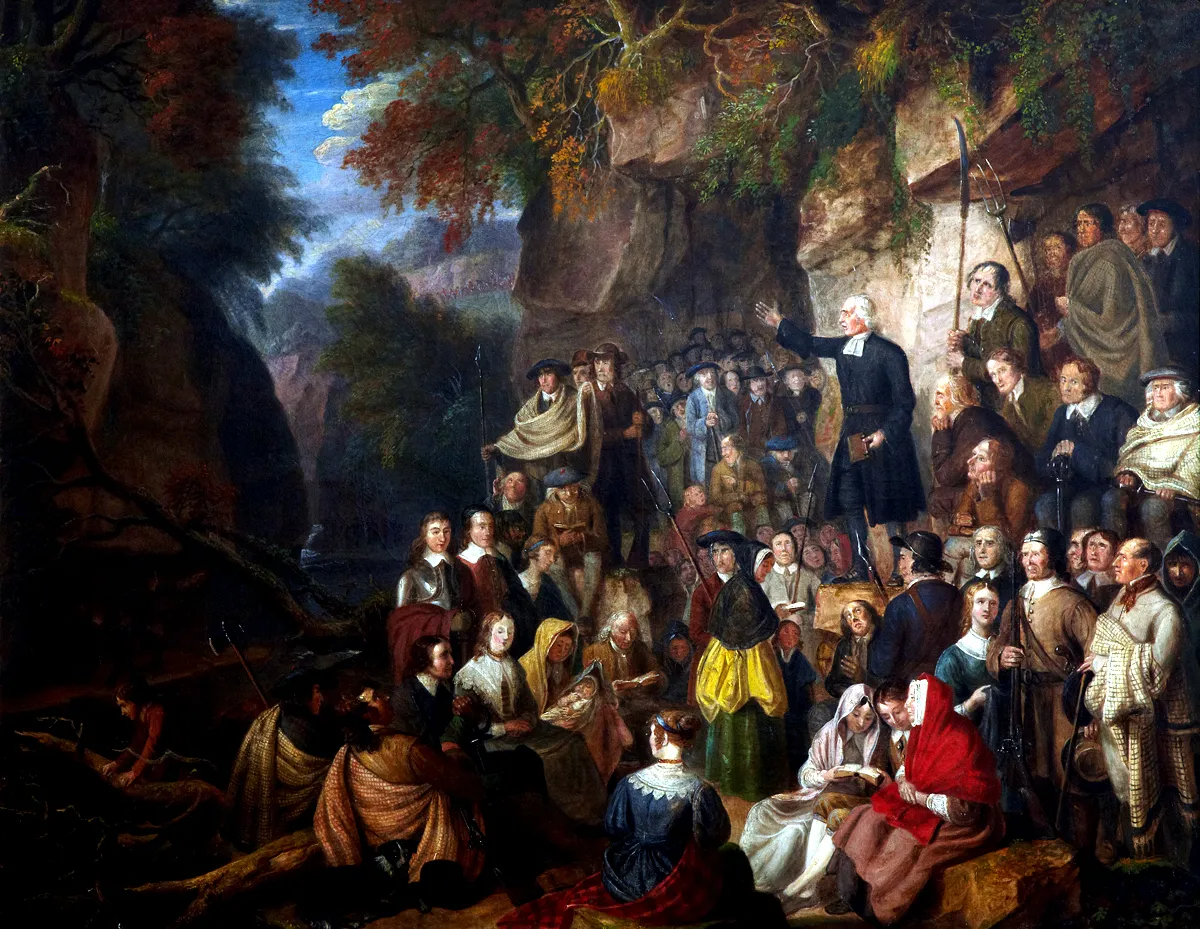
The Covenanters, Part 4: Archibald Johnson and Alexander Henderson

A lawyer and a minister walk into a Scottish Kirk… It sounds almost like the beginning set-up of a bad joke, but the lawyer Archibald Johnson and the minister Alexander Henderson were not joking when, on February 28th, 1638, they put forth the National Covenant before signers to be acknowledged and ratified by churches across Scotland. King Charles I viewed these men as treasonous fellows, and those who signed the National Covenant were effectively pitting themselves against the Throne. But these men did not mince their words when they wrote:
We… solemnly declare, that with our whole hearts we agree and resolve all the days of our life constantly to adhere unto and to defend the aforesaid true religion, and forbearing the practice of all novations already introduced in the matters of the worship of God, or approbation of the corruptions of the public government of the Kirk, or civil places and power of kirkmen, till they be tried and allowed in free assemblies and in Parliaments, to labour by all means lawful to recover the purity and liberty of the Gospel as it was established and professed before the aforesaid novations; and because, after due examination, we plainly perceive and undoubtedly believe that the innovations and evils contained in our supplications, complaints, and protestations have no warrant of the Word of God, are contrary to the articles of the aforesaid confessions, to the intention and meaning of the blessed reformers of religion in this land, to the above-written Acts of Parliament, and do sensibly tend to the re-establishing of the popish religion and tyranny, and to the subversion and ruin of the true reformed religion, and of our liberties, laws and estates… therefore from the knowledge and conscience of our duty to God, to our King and country, without any worldly respect or inducement so far as human infirmity will suffer, wishing a further measure of the grace of God for this effect, we promise and swear by the great name of the Lord our God to continue in the profession and obedience of the aforesaid religion; that we shall defend the same, and resist all these contrary errors and corruptions according to our vocation, and to the utmost of that power that God hath put into our hands, all the days of our life.[1]
Likely, some interpretation and explanation of these words is necessary. What Johnson and Henderson were putting forth before the Scots was a rich tapestry of ideas that saw as its crimson thread the gospel of Jesus Christ, from which springs forth the doctrines of grace, the pure and plain worship of the Triune God, and the duty of all men everywhere to bow the knee to Christ as King. They predominantly saw the innovations being put forth by men like King Charles I as a return to Roman and Popish traditions, and thus innovations to be resisted, rejected, and repealed. These men, and all subsequent signers of the National Covenant, saw the “re-establishing of the popish religion and tyranny,” as acting towards the “subversion and ruin of the true reformed religion, and of our liberties, laws and estates.” Though it borrowed heavily from the Scottish Covenant of 1580, the major addition was the final paragraph—the “General Bond”—whereby the Covenanters swore to oppose false religion, uphold true religion, and faithfully serve God as a nation:
Neither do we fear the foul aspersions of rebellion, combination or what else our adversaries from their craft and malice would put upon us, seeing what we do is so well warranted, and ariseth from an unfeigned desire to maintain the true worship of God, the majesty of our King, and the peace of the kingdom, for the common happiness of ourselves and posterity. And because we cannot look for a blessing from God upon our proceedings, except with our profession and subscription, we join such a life and conversation as beseemeth Christians who have renewed their covenant with God; we therefore faithfully promise, for ourselves, our followers, and all other under us, both in public, in our particular families and personal carriage, to endeavour to keep ourselves within the bounds of Christian liberty, and to be good examples to others of all godliness, soberness and righteousness, and of every duty we owe to God and man; and that this our union and conjunction may be observed without violation we call the living God, the searcher of our hearts to witness, who knoweth this to be our sincere desire and unfeigned resolution, as we shall answer to Jesus Christ in the great day, and under the pain of God’s everlasting wrath, and of infamy, and of loss of all honour and respect in this world; most humbly beseeching the Lord to strengthen us by His Holy Spirit for this end, and to bless our desires and proceedings with a happy success, that religion and righteousness may flourish in the land, to the glory of God, the honour of our King, and peace and comfort of us all.
In witness whereof we have subscribed with our hands all the premises, &c.[2]
Say one thing for the Covenanters; say they took their obligation to follow Christ soberly, whether privately or nationally.
This is not something that we often encounter in the 21st century, but the Reformed Scottish Kirk of the seventeenth century was thoroughly convinced that the liberty, prosperity, and blessings of their nation were mutually dependent upon the church’s faithfulness to Christ and His Word. They saw themselves, ultimately, as being a people and nation in covenant with God, and thus their covenantal duties and obligations were to walk according to God’s Word. Like Israel receiving from the mouth of the Lord both promised blessings for covenant obedience and promised curses for disobedience (Deut. 28), the Scottish Kirk saw itself as part of a nation which had received those same promises from the mouth of the Lord. If Popish innovations and practices would continue to defile the Kirk from within, then they believed the flame of judgment would burst forth from within and decimate the entire nation.
Thus, the National Covenant was not a mere novelty, nor the empty words of men making much ado about nothing. No, these men truly believed and meant every single word. And that means that both Johnson and Henderson are worthy of our attention if we will understand both the history and the theology of the Covenanters.
The Lawyer
If the name Archibald Johnson is not well-remembered in the annals of Church History today, then this is a modern oversight worth correcting. He had some of the largest roles to play in the chaos of Scotland between 1638 and 1663. Arguably, without Johnson, much of what happened immediately following the signing of the National Covenant would not have transpired.
He became well-known during the issues between Charles I and the Scottish Kirk, and for especially opposing the Laudian reforms. Along with Alexander Henderson, he was evidently viewed as a leader of the Covenanters, and one worthy of attention. In fact, having helped to co-author the National Covenant, he was subsequently appointed as the first Procurator to the General Assembly of the Church of Scotland in 1638. His legal advice was counted quite valuable then, as he was tasked with providing legal guidance and council to the Kirk, and eventually to the nation. He even had a relatively large role to play in the Westminster Assembly. Later, despite being adversaries, for political purposes Johnson would even be appointed King’s Advocate by King Charles I in 1646.
By 1657, Johnson would be recognized as one of the leading Remonstrants, and under the leadership of Lord Protector Oliver Cromwell, was re-named Lord Clerk Register after having lost the title seven years prior for having supposedly given extremely poor advice in 1650 during the Battle of Dunbar. (Likely, the true reason for being stripped of his title was due to the distrust that Cromwell has for the Remonstrants, who in turn distrusted him as leader of the New Model Army and a strong representative of Independent English Puritanism.) As a leading Remonstrant, Johnson believed that King Charles II, who had been appointed to rule after the death of his father, was unfit to rule. Though Charles II had declared allegiance to the National Covenant, men like Johnson believed his allegiance to be untrue—either he had been coerced into agreeing with the National Covenant, or else he was simply a liar.
For his part, Charles II did not think highly of Johnson (nor had Charles I, before him). It was Johnson’s Remonstrant belief that Charles II would need to be stripped of his power as king until he had demonstrated, over a period of time, lasting proof of his salvation. While Charles II had also signed off on The Solemn League and Covenant (which we will examine in the next piece), the Remonstrants were convinced he was merely trying to regain his throne and the power that came with it.
Along with all this, Johnson was also angry that the Scottish army was permitting former Royalists and Engagers (those who had tried to strike a deal with the imprisoned Charles I in 1657, promising to restore him to the throne because they feared the rise of the English Puritans), rather than permanently disavowing them. For Johnson, the greatest need of the hour was a pure and unblemished covenant faithfulness from the Scottish Kirk and nation, and neither Charles II nor his advocates could provide such faithfulness as the Lord required.
Ultimately, though the Remonstrants refused to fight for Charles II, they also refused to fight for Cromwell and the English army. They chose neutrality. Initially, Johnson appeared to be walking this line, as well, having first walked out of Parliament in protest when Royalists were permitted to join the Scottish army, and strongly blaming Charles I and II for many of the issues of the day.
However, Johnson appears to have had a change of heart at some point in the 1650’s, and though the Remonstrants distrusted the Independent English Puritans, Johnson evidently distrusted them less than Charles II. Johnson struck a deal with Oliver Cromwell and became a very influential leader in Cromwell’s cabinet.
This move proved to be Johnson’s undoing, however, when Charles II re-secured his throne after the death of Cromwell. With the monarchy back in full swing, Charles II had Johnson hunted down. He was eventually found in France, taken back to Scotland in chains, and hung publicly in Edinburgh in July of 1663. Following this, his head was cut from his body and placed on a spike at the city gates.
One may wonder, through it all, whether Johnson remained a Covenanter through to his death. The answer is a resounding “Yes!” His final words, before he was hung, are recounted for us:
I beseech you all who are the people of God not to scorn at suffering for the interest of Christ, or stumble at any thing of this kind falling out in these days. Be encouraged to suffer for him, for I assure you, in the name of the Lord, he will bear your charges! The Lord hath graciously comforted me… Pray! pray! praise! praise![3]
The Minister
While Johnson is distinctly remembered for his legal counsel and political affairs, Alexander Henderson is remembered distinctly for his commitment to the Scottish Kirk. If John Knox was the Founder of the Reformed Scottish Church and Presbyterianism as we know it, then Henderson can be thought of as the immediate successor who kept Presbyterianism thriving in the Kirk.
To give one an idea of how theologically gifted and pastorally respected Henderson one, it may only need be said that he was appointed to represent the Scottish Kirk when the Westminster Divines met during the Westminster Assembly.
His initial opposition to Charles I, and drawing of the National Covenant, occurred in 1637 when Charles I attempted to enforce the use of the Scottish Prayer Book on the Kirk. Almost immediately, it would seem that Henderson was viewed as a leader in this particular remonstrance.
First, when Henderson received the kingly edict that he (and all other Scottish ministers) had to go and purchase two copies of The Scottish Prayer Book within fifteen days, he immediately traveled to Edinburgh to challenge it. It had neither been approved by the General Assembly, nor was it a recognized Act of Parliament. While the privy council he had appealed to was favorable to Henderson, Charles I was not.
When many of the Scottish nonconformists gathered in Edinburgh, it was Henderson who was tasked once more with raising objections and concerns to the privy council. This time, King Charles I returned an even more forceful response: Not only would the prayer book still be required, but if those who had assembled in Edinburgh did not return home within 24-hours, they would be marked as treasonous rebels.
This was the final straw for Henderson and those who had gathered with him. With the help of Johnson, the previous National Covenant from 1580 was brought back to the table and reconfirmed. The result was National Covenant of 1638, which received a swift adoption and thousands of subscriptions.
The quick adoption of the National Covenant in 1638 was thanks in no small part to the fervent and able preaching of Henderson. For example, when Henderson traveled to Aberdeen with the National Covenant that same year, his preaching appears to have secured 500 signatures from the population there.
Not only was he an able preacher and pastor, but a respected theologian, as well. He was appointed as the Moderator of the General Assembly three separate times, and during the great Westminster Assembly, is chiefly credited with having penned the Directory for Public Worship.
While a lawyer and minister working together seems like the set-up to a joke, God used these two men in incredible ways for the Covenanters. The professions of these two men—Johnson and Henderson—dovetailed so well together for the task at hand that, by the grace of God, they produced arguably one of the finest and most succinct pieces of Covenanter history.
Next time, will zoom in on the Westminster Assembly, and examine the Solemn League and Covenant.
[1] National Covenant. Italics my own. See: https://www.fpchurch.org.uk/about-us/important-documents/the-national-covenant-1638/.
[2] Ibid.
[3] Except taken directly from https://josephsmithfoundation.org/sir-archibald-johnston-of-wariston/.
Image: By Alexander Carse – Art UK, Public Domain, https://commons.wikimedia.org/w/index.php?curid=28714653