The Letters of Revelation: Smyrna, Faithful Under Pressure

Be faithful unto death, and I will give you the crown of life.
Revelation 3:10
Don’t be deceived. You will die. It’s not a question of whether but when. The real question is, “How will you live when death approaches?” We live in a fallen world, we are attacked daily by the world, the flesh, and the devil. Saints on earth will always feel the pressure of this threefold evil until the King returns to bring us home. Jesus’ words to the church in Smyrna are perennial wisdom for saints in all ages.
Jesus’ refrain to all the churches resonates with those who are really his own: Rewards are bestowed upon his people if they hear his word, conquer, refuse the evil one, and endure till the end. Indeed, the Westminster Larger Catechism (Q&A 45) uses Revelation 2 to support the truth that Christ as our Kingly Mediator rewards his saints for their obedience.
Smyrna is one of only two churches that have nothing that points out sin, the other being the church in Philadelphia. Could these two churches be the Two Witnesses in Revelation 11? Perhaps, but that’s not the focus in this series. Jesus’ call to the Smyrnians is to remain faithful despite the hot attacks of the evil one. It’s easy to be faithful when all is well, but it’s a time of true testing of courage and commitment when evil is hot on your heels.
Jesus is well aware of the situation the Smyrnians find themselves in. As promised, they face tribulation in this life. They’re financially poor but spiritually rich. They’ve been attacked by the same class of people who rejected Jesus: The first-century Jews, who worship in a synagogue of Satan (v. 9). Jesus doesn’t remove the trial from them, and he doesn’t promise them an earthly deliverance from it. Instead, he urges faithfulness in the face of hot opposition. He steels their spirit, “Do not fear. Brace yourself for battle.” Some of them will be cast into prison for “ten days” (which could mean 10 days, or symbolically mean 10 months, or even 10 years). Like Daniel who was tested for ten days (Daniel 1:12-15), there’s an appointed period of persecution that the Smyrnian saints will need to endure and which will test their faithfulness. But just as Daniel and his friends were faithful and rewarded, the saints in Smyrna will receive divine blessing for their faith-filled perseverance. Jesus strengthens their souls, “Be faithful unto death” (v. 10), for if they do, they “will not be hurt by the second death” (v. 11).
Saints on earth cannot sacrifice eternal life for earthly life, freedom in Christ for freedom from death. Death will come. Will the second death affect us? Not if we’re truly in Christ. Here’s the King’s promise: The one who died and came to life (v. 9) will give life to the dead saints in Smyrna. That promise rings true for all who hear what his Spirit says to the Church, for all who conquer, and for all who persevere till the end.
Faithfulness is not the way of salvation but the work of salvation. It is not the cause of union with Christ but the fruit of the union. As the Apostle John says elsewhere, “They went out from us, but they were not of us; for if they had been of us, they would have continued with us. But they went out, that it might become plain that they all are not of us” (1 John 2:19). Saints in Smyrna and beyond give witness to the work of Christ by his Spirit through their faithfulness. Everyone attached to the Vine bears fruit, and this fruit is seen in faithfulness (John 15).
Not even a century after Jesus’ words to Smyrna, a man named Polycarp came on the scene. Polycarp was born around 69 AD. Personally, I think Revelation was written in the mid-60s and before AD 70. But even a later date of composition of Revelation still places Polycarp close at hand. He became a disciple of the Apostle John, and he lived to the age of 86. In God’s providence, he would grow up to inherit the pressures spoken of in Revelation 2. He eventually became the bishop (or pastor) of Smyrna. All eyes would be looking to him on how to live faithfully in the public eye.
In God’s unfolding of history, after more than eight decades of living under God’s gracious eye, Polycarp was arrested and led into an amphitheater. He was an older man, and the soldiers wanted to spare him some suffering. They gave him a chance to recant and be free. They told him to consider his age and frailty. The torture would not be light, and he would die. Anticipating Martin Luther and encouraging future martyrs, he refused to recant. The man was martyred. His faithful witness reverberated in the Roman Empire, and it has fortified saints for centuries. In The Martyrdom of Polycarp, some of his final words testified to his unwavering commitment to Christ: “Eighty-six years I have been Christ’s servant, and he has done me no wrong. How can I blaspheme my King who saved me?”
Christ the King has given his servant Polycarp his reward, even the crown of life. Christ remains our King. The fight rages on. The battle continues. In this world, we will have trials and tribulation. But we can take heart, because Christ has overcome the world (John 16:33). When the world overcomes your earthly life, as you remain faithful to Christ, know that you are the true overcomer, because you’re joined to the One who conquered death by rising from the dead for your eternal life. It is his good pleasure to crown your undeserving but richly rewarded head with his life. Take heart, and be faithful, dear saints. Christ is King. Christ is Life.
Rev. Dr. Michael Mock is the Pastor of Grace Presbyterian Church (PCA) in Fresno, CA and an ACBC-certified Biblical Counselor. He’s the author of Hey, Dad, Why Do We…?: Kids Ask the Greatest Questions, Old Testament Introduction and Workbook, New Testament Introduction and Workbook, Comfort from Corinthians: A Devotional Walkthrough of 2nd Corinthians for Sinful and Struggling Saints, and A Confessional Marriage: Marriage Based on the Firm Foundation and a Faithful Confession. You can find his books here: Amazon.com: Dr. Michael D. Mock: books, biography, latest update.
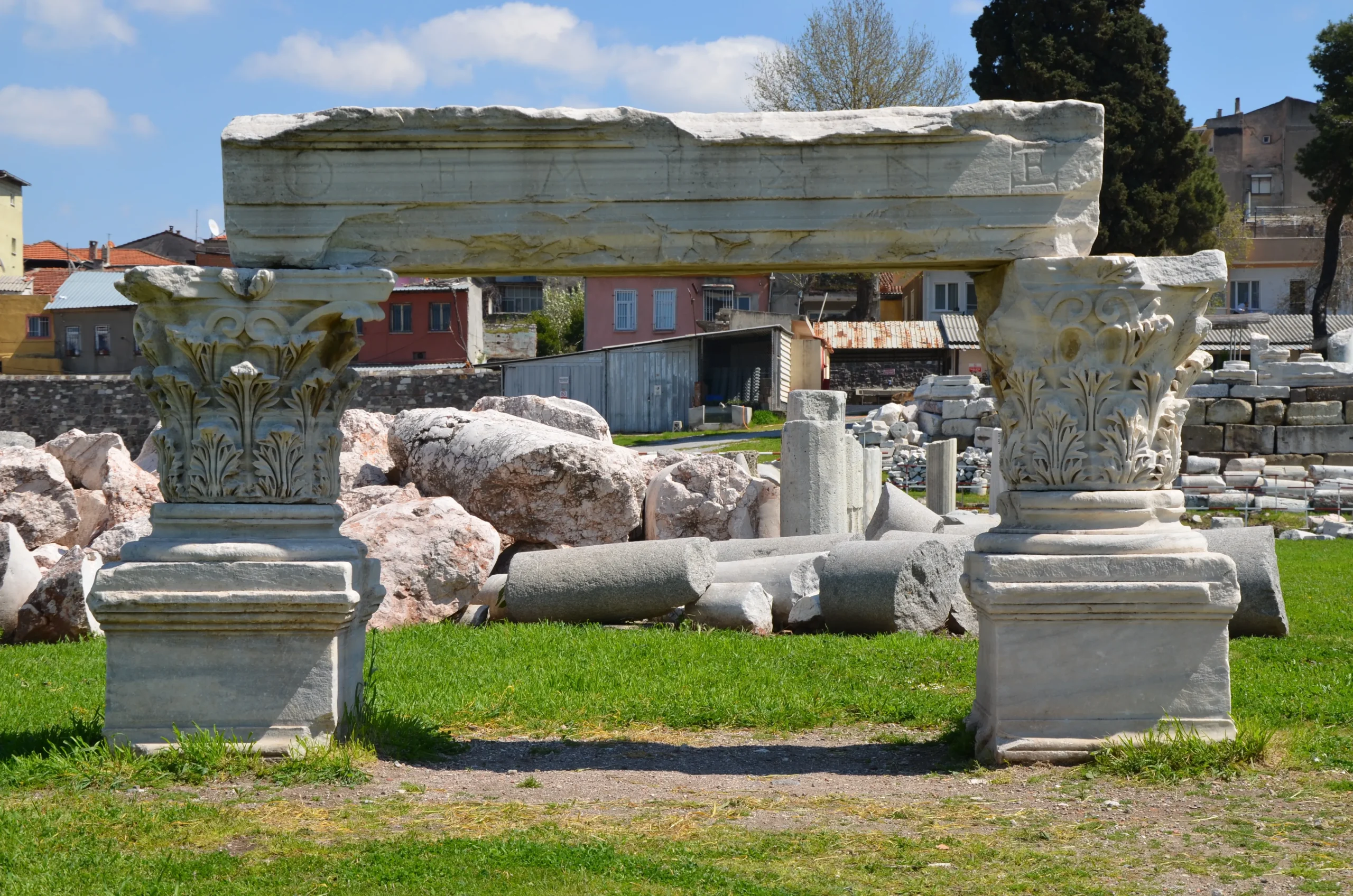
Photo: By Carole Raddato from FRANKFURT, Germany – Agora of Smyrna, built during the Hellenistic era at the base of Pagos Hill and totally rebuilt under Marcus Aurelius after the destructive 178 AD earthquake, Izmir, Turkey, CC BY-SA 2.0, https://commons.wikimedia.org/w/index.php?curid=45906905