The Sword of Christ: The City of Pergamos

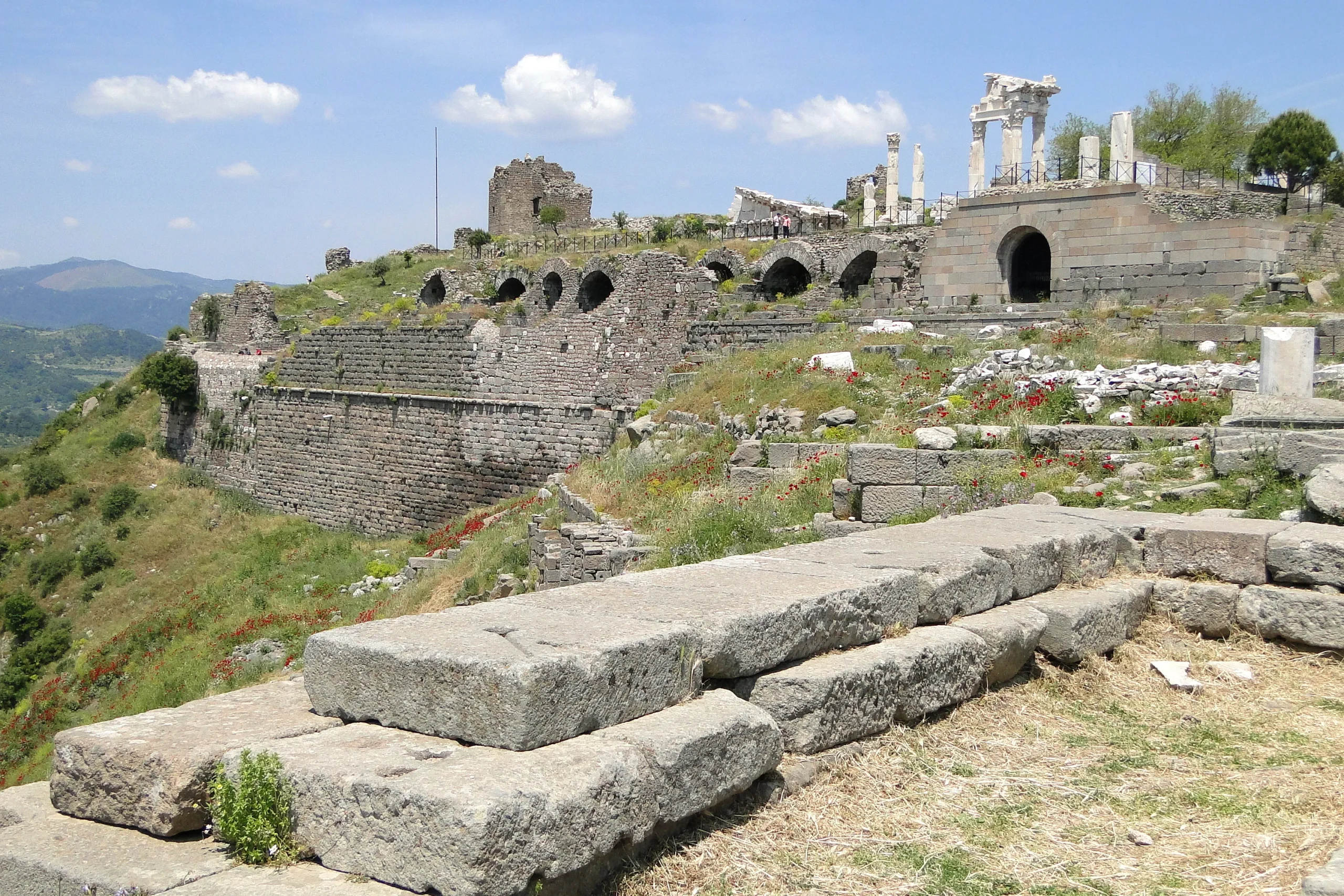
Pergamos was one of the most influential cities of the ancient world. Built upon a massive rocky hill, it dominated the surrounding countryside both geographically and politically. The Romans made it the capital of the province of Asia, making it a center of wealth, learning, and imperial power. Its famous library reportedly contained some 200,000 volumes. Yet Pergamos was also a city consumed with pagan religion. Temples dedicated to Athena, Dionysus, and the enormous altar of Zeus towered over the city. As the provincial capital, it was also the center of emperor worship. In such an environment it is not surprising that Christ describes Pergamos as “where Satan’s throne is” and “where Satan dwells.”
A Sword to Divide
Against this dark backdrop, Christ introduces Himself as “He who has the sharp two-edged sword.” This stands in contrast to the Romans for whom the sword was a symbol of imperial authority. Jesus reminds His church that ultimate authority belongs to Him alone. What is more, His sword is not merely a weapon of judgment but also an instrument of separation, distinguishing the faithful from the unfaithful.
The Lord first commends the believers for their steadfastness. He says, “I know where you dwell.” Christ is fully aware of the difficult circumstances in which His people live. He does not instruct them to flee the city but calls them to remain faithful within it. Though surrounded by paganism and pressured to worship Caesar, they had “held fast” His name. Their confession had not wavered, even during the days when Antipas, Christ’s “faithful witness,” was martyred among them. The church’s greatest strength was not its favorable circumstances but the presence of Christ Himself.
A Sword to Expose
Yet Christ’s penetrating sword also exposes sin within His church. Some in Pergamos had embraced the teaching of Balaam. Just as Balaam advised Balak to corrupt Israel through compromise with pagan worship and sexual immorality (Numbers 22–25), so false teachers in Pergamos encouraged believers to accommodate the surrounding culture. Others followed the teaching of the Nicolaitans, who apparently argued that Christians could unite the worship of Christ with the practices of pagan society. Though little is known about this group, their error was clear: they sought to marry the church to the world.
The temptation remains the same today. Whenever the church embraces the moral standards or worldview of an unbelieving culture instead of submitting to Scripture, it repeats the sin of Pergamos. Whether through the rejection of biblical sexual ethics, the sanctity of life, or the authority of God’s Word, compromise always invites Christ’s discipline.
Therefore, Christ commands His church to repent. If they refuse, He Himself will come and fight against the false teachers with the sword of His mouth. The One who strengthens His people also purifies His church.
For those who overcome, however, Christ promises rich blessings. They will receive the hidden manna, the heavenly nourishment found in Christ Himself. They will also receive a white stone bearing a new name. Throughout Scripture the “new name” points to the saving revelation of Christ. Only those who belong to Him truly know that name, just as only believers partake of the hidden manna. Those who remain faithful in Satan’s city will discover that Christ is both their strength in this life and their everlasting reward in the life to come.
Image: By Adam Jones from Kelowna, BC, Canada – Acropolis – Bergama (Pergamon) – Turkey – 10, CC BY-SA 2.0, https://commons.wikimedia.org/w/index.php?curid=64144412