The Magnificat: The First Christmas Song, Pt 1

I would imagine that most if not all of those reading this article have read or at least heard of the book The Pilgrim’s Progress, the allegorical story about a man named Christian and his journey from the City of Destruction to the Celestial City. Spurgeon once said this about its author, John Bunyan:
“Read anything of his, and you will see that it is almost like reading the Bible itself. He had read it till his very soul was saturated with Scripture; and though his writings are charmingly full of poetry, yet he cannot give us his Pilgrim’s Progress…without continually making us feel and say, “Why, this man is a living Bible!” Prick him anywhere—his blood is Bibline, the very essence of the Bible flows from him. He cannot speak without quoting a text, for his very soul is full of the Word of God.”[1]
When we study Mary’s Magnificat in Luke 1, we could say the exact same thing about Mary: her blood was Bibline. Though we do not hear about this passage talked about very often from the pulpit at Christmas time, my own personal study of it last Christmas revealed to me just how rich a passage it is. Allow me to show you why.
We find Mary’s Magnificat in verses 46-55 of the 80 verse, first chapter of Luke’s gospel. We call it the Magnificat because it is the first word of the Latin translation of the text. Luke begins with the announcements of the coming births of John the Baptist and Jesus, both of which happen through miraculous means. In verses 5-25, John the Baptist is promised by an angelic messenger to Zacharias and Elizabeth, a couple barren and advanced in years. Elizabeth’s ability to conceive at this point would have been by human means impossible. But with God, all things are possible, and she conceives in her old age.
Next, Luke tells us of the promised birth of Jesus in an equally impossible situation – through the womb of a virgin, the cousin of Zacharias and Elizabeth, whose name is Mary (v. 26-38). This is where we first meet the mother of our Lord in this gospel. What can we learn about Mary from this text?
Her name is the Greek version of the Hebrew Miriam, which means “exalted one.” This is extremely fitting as we will shall see.
She lived in a town called Nazareth, located about 70 miles north of Jerusalem in the region of Galilee (v. 26). Galilee tended to be a more Gentile area, but Luke 4:16 tells us that Nazareth had a Jewish synagogue that Mary and her family likely attended. The town itself was small, insignificant, had a low reputation, and was viewed with disdain (Jn. 1:45-46).
Mary is a virgin (v. 27). Therefore, Jesus could not have been conceived through human means.
She is engaged to a man named Joseph, a descendent of the line of David (v. 27). In those times, there was a one-year period between the betrothal and the wedding ceremony, but the couple was still considered married. That is what Mary and Joseph were in the midst of now. Mary was still at home and Joseph would have been preparing a home for her. When we picture Mary, we probably think of a girl who is a young adult age, as is normal today. But back then, girls got engaged much younger. More likely, Mary was actually twelve or thirteen, just a young teenager.
And yet, despite her humble, unlikely circumstances, John MacArthur makes this comment, “Out of all the women He could have chosen – queens, princesses, sisters or daughters of the wealthy and influential – He chose an unknown, unassuming young woman named Mary from an obscure village called Nazareth.”[2] Mary receives the announcement from the angel Gabriel that she would conceive by the Holy Spirit and bear a son whose name would be Jesus, the Son of God, and the fulfillment of the Abrahamic and Davidic Covenants. Though she surely did not fully understand how or why this would happen to her, she responds with these words, “Behold, the slave of the Lord; may it be done to me according to your word” (Lk. 1:38). Again, MacArthur says, “Mary instantly, humbly, and joyfully submitted to God’s will without further doubt or question.”[3]
This was not a small thing that she was agreeing to. Her betrothal meant she and Joseph were not yet living together, but they were considered married. Joseph would know the child was not his so it would look like she had relations with some other man, which would constitute adultery. And the consequence for adultery according to the Law was death by stoning. Yet, knowing how it would be perceived, Mary agreed by faith.
Immediately after, she goes to see Zacharias and Elizabeth (Lk. 1:39-45). Gabriel had also told her that Elizabeth had conceived in her old age and was six months pregnant. Having just heard some unbelievable news of her own, seeing whether this pregnancy was true would confirm for Mary the message of the angel and the ability for God to bring about a miraculous conception in her own womb. As Mary arrives, the baby in Elizabeth’s womb leaps for joy and Elizabeth responds with joy and blessing for Mary and the fruit of her womb. Just like that, Mary now had confirmation of another miraculous conception and the affirmation of Who it was she carried. That’s all she needed to know that what the angel had told her was true.
In response to all these things, she burst out in this prayer of thanksgiving. There are no requests or supplications, just pure praise that magnifies God, His Word, and His work.
To be continued.
[1] https://www.thegospelcoalition.org/blogs/justin-taylor/do-you-bleed-bibline/
[2] MacArthur, John. God in the Manger: The Miraculous Birth of Christ. W. Publishing Group, 2001, pg. 31.
[3] MacArthur, John. 40 Lives in 40 Days. Thomas Nelson, 2022, pg. 88-89.
Madelyn Moses (MA Biblical Studies, The Master’s University) resides in Bucks County, PA and attends The Master’s Church of Bucks County in Richboro, PA. Follow her writing at Meditations & Musings on Facebook and Instagram.
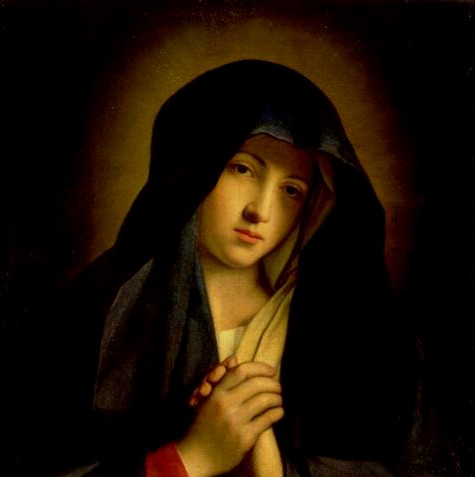
Picture: By Giovanni Battista Salvi da Sassoferrato – http://www.bridgemanartondemand.com/art/104827/The_Madonna_in_Sorrow, Public Domain, https://commons.wikimedia.org/w/index.php?curid=6091994